
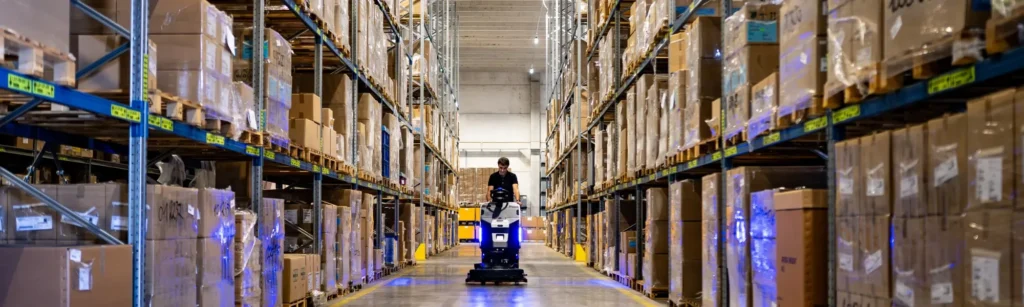
3PL stands for third-party logistics. A 3PL is an outside company that stores your inventory, packs and ships your orders, and handles returns, so you don’t have to run your own warehouse.
Online brands use them, and so do manufacturers shipping pallets to retail chains and publishers mailing catalogs. Below, you’ll see how a 3PL works day to day, what it charges for, how it differs from a 4PL, and the signs that it’s time to hire one.
What Does 3PL Mean?
3PL is short for third-party logistics. The ASCM Supply Chain Dictionary describes it as “a buyer and supplier team with a third party that provides product delivery services.” In plain terms, you’re the first party, your customer is the second, and the 3PL is the outside company handling everything physical in between.
Some 3PLs handle a single piece of that work, like storage or freight. Others run the whole chain, from the receiving dock to the customer’s front door.
Gartner’s definition adds a detail that clears up a lot of confusion. In its 2026 Magic Quadrant for third-party logistics, Gartner describes a 3PL as a provider that moves, stores, and manages products for customers for a fee without ever owning them. A 3PL holds and ships your inventory, but the inventory stays yours, so your contract needs clear terms on liability, damage, and count accuracy.
That ownership point is also why a 3PL warehouse runs differently from a company’s own distribution site. Our guide to fulfillment center vs. distribution center vs. warehouse walks through how each type of building operates.
How Does a 3PL Work?
A company that sells candles on its own website and also ships cases to two regional grocery chains makes a good example. Here’s how one of its orders travels through a 3PL.
1. You Send Inventory to the 3PL’s Warehouse
Product arrives from your factory or supplier by pallet, carton, or container, with an advance notice telling the 3PL what’s coming. Most 3PLs also ask for product dimensions and weights up front so they can plan where everything will live.
2. The 3PL Receives, Counts, and Stores It
Staff check the shipment against that notice, log it into their warehouse management system, and put it away in a bin, shelf, or pallet location. Short shipments and damaged cartons get flagged to you right away.
From then on, you can see live stock counts without walking a warehouse floor.
3. Orders Flow In From Your Store, Marketplace, or Retailers
Most 3PLs connect directly to your e-commerce platform, marketplaces, and ERP. Web orders arrive automatically. Retail purchase orders usually come through EDI.
4. The 3PL Picks, Packs, and Ships Each Order
For a web order, a picker pulls the items, a packer boxes them, and the order leaves with a carrier label and tracking number that flows back to your system. Retail orders look different, usually full cases on pallets, labeled to each grocery chain’s specifications.
Our walkthrough of the pick, pack and ship process covers each step in detail.
5. Returns Come Back to the 3PL
Returned items are inspected, then restocked, repackaged, or set aside depending on their condition and your instructions. Many 3PLs also report on return reasons, which can point you to a product or packaging problem worth fixing.
What Services Does a 3PL Provide?
The basics look similar from one provider to the next. Receiving, storage, inventory tracking, order fulfillment, transportation, and returns cover most of it.
A 3PL warehouse is the building where all of that happens, shared by many client businesses at once. Your stock sits on the same floor as other companies’ products but is tracked, counted, and billed separately.
Where 3PLs differ is the work beyond direct-to-consumer parcels, and most explanations of 3PLs skip it. Plenty of companies need business-to-business services:
- Retail distribution that follows each chain’s routing guide, labeling rules, and EDI requirements
- Kitting and assembly, such as building sample kits, gift sets, or multi-part products before they ship
- Literature and promotional fulfillment for brochures, point-of-sale displays, and trade show materials
- Amazon FBA prep, including labeling and packaging inventory to Amazon’s inbound standards
Retail work is the area that trips companies up most. Big-box chains publish strict rules for how cases are labeled, how shipments are booked, and how documents are sent, and they bill vendors for misses.
Ask any provider about their retail EDI compliance experience with your specific accounts, and ask how they handle a new retailer’s onboarding. Confirm a 3PL can meet each retailer’s routing guide and EDI requirements before you sign, not after your first compliance chargeback.
What Are the Main Types of 3PL Providers?
The clearest way to sort 3PLs comes from Armstrong & Associates, the research firm that tracks the market. Its 2026 market report puts the U.S. 3PL market at $323.4 billion in gross revenue for 2025, split across four segments.
| Segment | What it covers | 2025 U.S. gross revenue |
|---|---|---|
| Domestic Transportation Management | Arranging and managing freight within the U.S., including brokerage | $128.3 billion |
| International Transportation Management | Freight forwarding and customs work for imports and exports | $85.9 billion |
| Dedicated Contract Carriage | Trucks and drivers assigned to one shipper under contract | $32.0 billion |
| Value-Added Warehousing and Distribution | Storage, fulfillment, and services like kitting and labeling | $72.7 billion |
Providers also split by what they own. Asset-based 3PLs run their own warehouses, trucks, or both. Non-asset 3PLs coordinate capacity that belongs to other companies, which gives them flexibility but less direct control over the floor.
Plenty of larger providers work across more than one of these segments, pairing a warehouse network with a freight brokerage, for example. Smaller and regional 3PLs tend to focus on one or two and go deep on them.
If you’re outsourcing storage and order fulfillment, you’re shopping in the value-added warehousing segment, and you’ll want a provider that runs its own warehousing and distribution services rather than brokering space.
3PL vs. 4PL: What’s the Difference?
A 3PL runs specific logistics work for you. A 4PL manages your entire logistics network, and that network often includes several 3PLs.
| Feature | 3PL | 4PL |
|---|---|---|
| What they do | Store, pick, pack, and ship, or move freight | Plan and manage the whole supply chain |
| Who they manage | Their own warehouse teams and carriers | Multiple 3PLs, carriers, and systems on your behalf |
| Control you keep | High. You pick the providers and set the rules | Lower. The 4PL makes most provider decisions |
| Runs its own warehouses | Often | Rarely |
| Best fit | Companies outsourcing storage, fulfillment, or freight | Large companies with complex, multi-region networks |
In practice, a growing apparel brand shipping from one region hires a 3PL to store stock and ship web orders. A national manufacturer with plants in four states and a dozen carriers might hire a 4PL to coordinate all of it, including picking which 3PLs run each warehouse.
The rest of the ladder is shorter. A 1PL is a company handling its own logistics in-house, and a 2PL is an asset owner, like a trucking company or ocean carrier, that moves your goods but doesn’t manage your operation.
The term 5PL gets used loosely, usually for a provider coordinating several supply networks through a technology platform.
How Much Does a 3PL Cost?
Every 3PL quotes differently, but most bills are built from the same parts: a setup or onboarding fee, receiving fees when inventory arrives, monthly storage by pallet, shelf, or cubic foot, and pick and pack fees per order or per item. Packaging materials, shipping, and any monthly minimum or account fee land on top.
Your order profile drives the total more than any single rate. Order volume, items per order, product size, the space your inventory takes up, and special handling all shift the math.
Storage billing varies more than people expect. One 3PL charges per pallet position, another per shelf or bin, and a third by the cubic foot, so the same inventory can price very differently.
Ask whether any rates change during peak season, too. Our breakdown of how fulfillment pricing is determined goes deeper on each line item.
Ask every 3PL for a sample invoice built on your real order profile before you sign, so you can compare providers on the same terms. Rate sheets that look cheaper per pick can cost more once storage and minimums are added in.
Pros and Cons of Using a 3PL
Most companies that outsource are happy with it. The 2027 Third-Party Logistics Study, produced with CSCMP, Penske Logistics, and NTT DATA, found that 97% of shippers call their 3PL relationships successful, and 86% say they’re increasing their use of outsourced logistics. The same study also shows where expectations need adjusting.
Pros
You stop carrying a warehouse lease, warehouse staff, and the equipment that goes with them. Capacity flexes with seasonal peaks without hiring for December and laying off in January. You also get access to carrier rates and fulfillment technology that would be hard to justify buying on your own, and your team gets its time back for product and sales.
Cons
You give up some direct control over the floor, and getting systems connected takes real work up front. Cost savings aren’t automatic either. In the 2027 study, the share of shippers crediting their 3PL with lowering overall costs fell to 52%, down from 75%.
There’s a technology perception gap too: 70% of shippers are satisfied with their 3PL’s technology, while 94% of 3PLs believe their customers are. Contract terms, minimums, and exit clauses deserve a careful read before you sign.
When Should a Business Use a 3PL?
A few signals show up again and again. You’re running out of space and pricing out a bigger lease, or packing and shipping are eating hours your team should spend on product, sales, and customers.
Growth into new regions counts as well. Shipping across the country from one building adds days and dollars to orders headed far from it, and a provider with locations closer to those customers can cut both.
Seasonal peaks are another. If you hire temporary staff every fall and still ship late in December, outsourced capacity can cost less than building for a peak that lasts six weeks. The same goes for new retail or wholesale accounts with compliance rules you can’t meet in-house.
One more signal applies to companies that already outsource. If your current provider keeps missing ship deadlines or accuracy targets, it may be time to switch 3PL providers rather than keep absorbing the cost of their mistakes.
Common Questions About 3PLs
What Does 3PL Stand For?
3PL stands for third-party logistics. It refers to an outside company that handles storage, order fulfillment, shipping, or freight for other businesses, sitting between you, the seller, and your customer, the buyer. You’ll also see it written as TPL in some supply chain material.
Is Amazon a 3PL?
In part, yes. Armstrong & Associates ranks Amazon first among U.S.-based 3PLs by 2025 gross logistics revenue in its 2026 rankings, based on its third-party seller services segment. Armstrong estimates most of that segment is 3PL work, such as storing and shipping inventory for sellers through Fulfillment by Amazon.
What Is a 3PL Warehouse?
A 3PL warehouse is a facility run by a third-party logistics provider that stores and ships inventory for many client businesses at once. Each client’s stock is tracked separately in the provider’s warehouse management system, and clients pay for the space and services they use instead of leasing a building.
Is a Freight Broker a 3PL?
Some are. A broker that arranges truck capacity for shippers falls under the transportation side of the 3PL market. Many 3PLs combine brokerage with warehousing, but a broker that only books freight won’t store or fulfill your inventory.
How to Choose the Right 3PL Provider
A 3PL stores your inventory without owning it, bills you for receiving, storage, and each order it ships, and works best when its locations, systems, and experience match how you sell. Visit the warehouse in person if you can, and watch how orders move across the floor. Then vet each provider on these points before you sign:
- Where their warehouses sit relative to your customers
- Which sales channels and retail accounts they already ship for
- How their systems connect to your store, marketplaces, and ERP
- What an invoice looks like for your actual order profile
- References from a client who switched to them from another provider
Weigh each 3PL’s warehouse locations against where your customers are, since distance drives both shipping cost and delivery time. Meyer runs warehousing and fulfillment for e-commerce brands, publishers, and B2B companies across the Northeast, with integrations into the platforms most sellers already use.
If you’re weighing a first 3PL or a better one, take a look at our storage and fulfillment services and reach out for a quote built on your own order data.